Moving Beyond After-School Care to Build a Second Home for Children
Key Takeaways
- How Seagull, an education branding agency, helped HiFive establish a distinctive market position.
- The role of education branding strategy in creating an emotionally relevant brand.
- How category ownership differentiated HiFive from conventional after-school offerings.
- How integrated communication connected brand building with business objectives.
Building More Than an After-School Space.
Building a Growth Ecosystem.
Parenting has changed.
Working parents want their children to develop confidence, curiosity and emotional resilience alongside academic skills. Yet balancing demanding careers with the many needs of a growing child can be challenging.
That was the opportunity with HiFive.
The brand needed a distinctive identity and a communication strategy that reflected its larger role in children’s lives.
The challenge was clear:
How do we position an after-school brand as a trusted partner in a child’s growth?
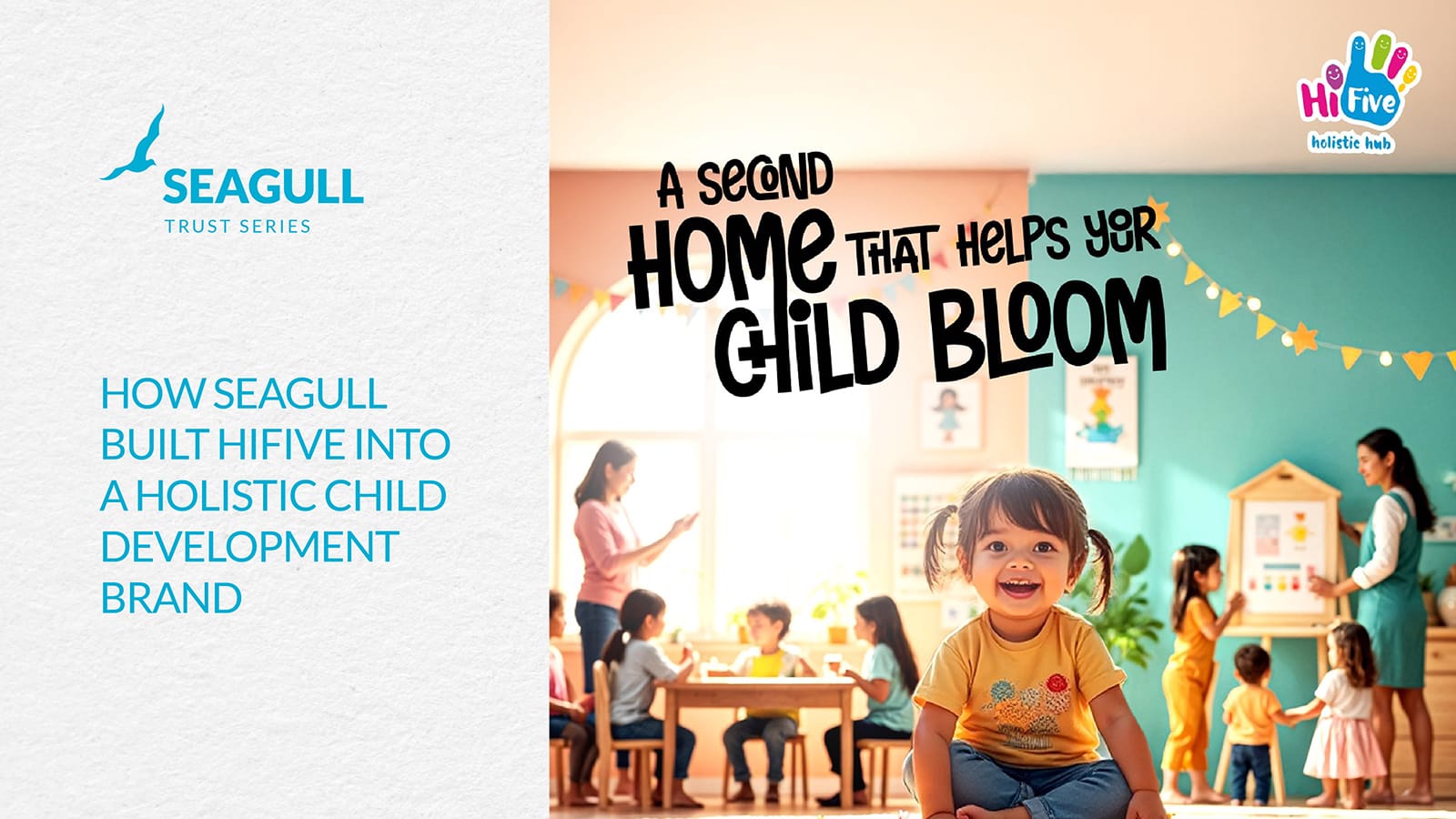
Through our structured education branding strategy, Seagull worked on defining HiFive’s positioning, identifying its audience’s emotional drivers and building a communication framework around one central idea: A Second Home That Helps Your Child Bloom.
The idea connected two important needs. Children need an environment where they can grow into confident, happy individuals. Parents need the reassurance of a trusted ally who supports them along the way.
This became the foundation of HiFive’s brand story.
Defining the Brand Beyond After-School Care
Every distinctive brand begins with understanding what matters to its audience.
For HiFive, the opportunity was to move beyond supervision, tuition and extracurricular activities to address a larger need: holistic child development.
Our exploration of parent insights revealed two powerful emotional truths. Parents want their children to bloom into confident, happy individuals. At the same time, many working parents feel they lack the time and support to manage every aspect of their child’s development.
Seagull translated these insights into a positioning that focused on an environment where children learn, discover, play and develop, while parents gain the reassurance of a dependable support system.
Because childhood development goes far beyond the classroom.
Creating a Category of Its Own
The next challenge was differentiation.
How could HiFive stand apart in a market already occupied by schools, daycares, tuition classes and hobby centres?
Through our category ownership strategy, Seagull positioned HiFive as India’s First Branded After-School Growth Hub.
The proposition established a clear distinction:
- Not a school. A space that complements formal education.
- Not a daycare. An environment focused on development, not supervision alone.
- Not a tuition class. An approach that extends beyond marks to confidence and curiosity.
- Not a hobby centre. A structured ecosystem integrating emotional growth, academic support, culture and play.
This positioning gave HiFive a distinct identity and a clearer reason for parents to consider it.
For brands exploring how to build an education brand in India, differentiation begins with defining the value a brand brings beyond its core service. HiFive’s category proposition also supported its wider ambitions through a positioning that could be carried forward across a structured franchise model.
Building Communication Around What Parents Feel
A strong position creates direction. Meaningful communication makes it relatable.
Seagull identified four core ideas to guide HiFive’s communication:
- A Second Home That Helps Your Child Bloom — the master brand idea.
- You’re Not Alone in Raising Your Child — the trust narrative.
- Where Childhood Meets Culture — the differentiation narrative.
- India’s First After-School Growth Hub — the category-defining proposition.
Together, these ideas created a consistent foundation for the brand’s messaging, connecting parents’ aspirations with HiFive’s larger purpose.
These brand building strategies for education brand development went beyond visibility to establish an identity that parents could understand, relate to and remember.
Creating a Connected Communication Strategy
With the brand’s positioning established, Seagull structured an integrated communication plan around three wings.
Wings for Design focused on shaping a consistent brand identity and translating HiFive’s core idea, A Second Home That Helps Your Child Bloom, into meaningful communication for parents.
Wings for Reach brought together long-form storytelling through parenting-focused videos, collaborations with parenting and motherhood influencers, a planned social media calendar of 16 to 20 posts per month, and project-based PR across traditional and digital media. Each channel helped build awareness, credibility and familiarity with the brand.
Wings for Profit focused on turning interest into action through lead generation campaigns that encouraged parents to book counselling sessions.
Together, these initiatives connected brand awareness with trust-building and measurable action. The emphasis on consistent brand expression also reflects the role of creative education design in shaping a cohesive experience. Specific educational design services would depend on the actual scope of delivery.
Connecting Brand Strategy to Business Growth
The strategy was aligned with a clear objective: building trust with working parents in Pune and generating consistent monthly counselling session bookings.
The planned audience included families in residential areas such as Baner, Bavdhan, Kothrud and Prabhat Road.
By bringing together storytelling, influencer collaborations, social media, performance marketing and PR, Seagull created a framework designed to connect HiFive’s emotional promise with its business goals.
The plan was mapped to June through December 2025, with counselling bookings serving as the measurable objective.
Conclusion
Building HiFive’s brand foundation required more than promoting an after-school programme. It required a distinctive position, an emotionally relevant brand idea and a communication strategy built around the needs of parents and children.
Through strategic positioning, category ownership and its five-wing communication framework, Seagull established the foundation for HiFive to stand apart as India’s First Branded After-School Growth Hub.
Because the value of an after-school growth hub lies not simply in how it fills a child’s day.
It lies in how it helps shape the person that child grows up to become.
FAQs
- What makes HiFive different from conventional after-school programmes?
HiFive is positioned as India’s First Branded After-School Growth Hub, bringing together academic support, emotional development, culture and play in one integrated ecosystem. - How did Seagull help build HiFive’s brand?
Seagull developed HiFive’s brand positioning, category ownership strategy and communication framework to establish a distinctive identity centred on holistic child development and parental reassurance. - What was HiFive’s core brand idea?
A Second Home That Helps Your Child Bloom became HiFive’s central brand idea, reflecting its role in helping children develop confidence, curiosity and emotional resilience while giving parents a dependable support system. - What role did education branding strategy play in HiFive’s development?
The education branding strategy helped HiFive move beyond conventional after-school care by identifying its audience’s emotional needs, defining a distinctive market position and creating consistent brand communication. - How did Seagull’s communication strategy support HiFive’s business objectives?
Seagull integrated storytelling, influencer collaborations, social media, PR and performance marketing to build awareness and trust among parents while encouraging them to book counselling sessions.