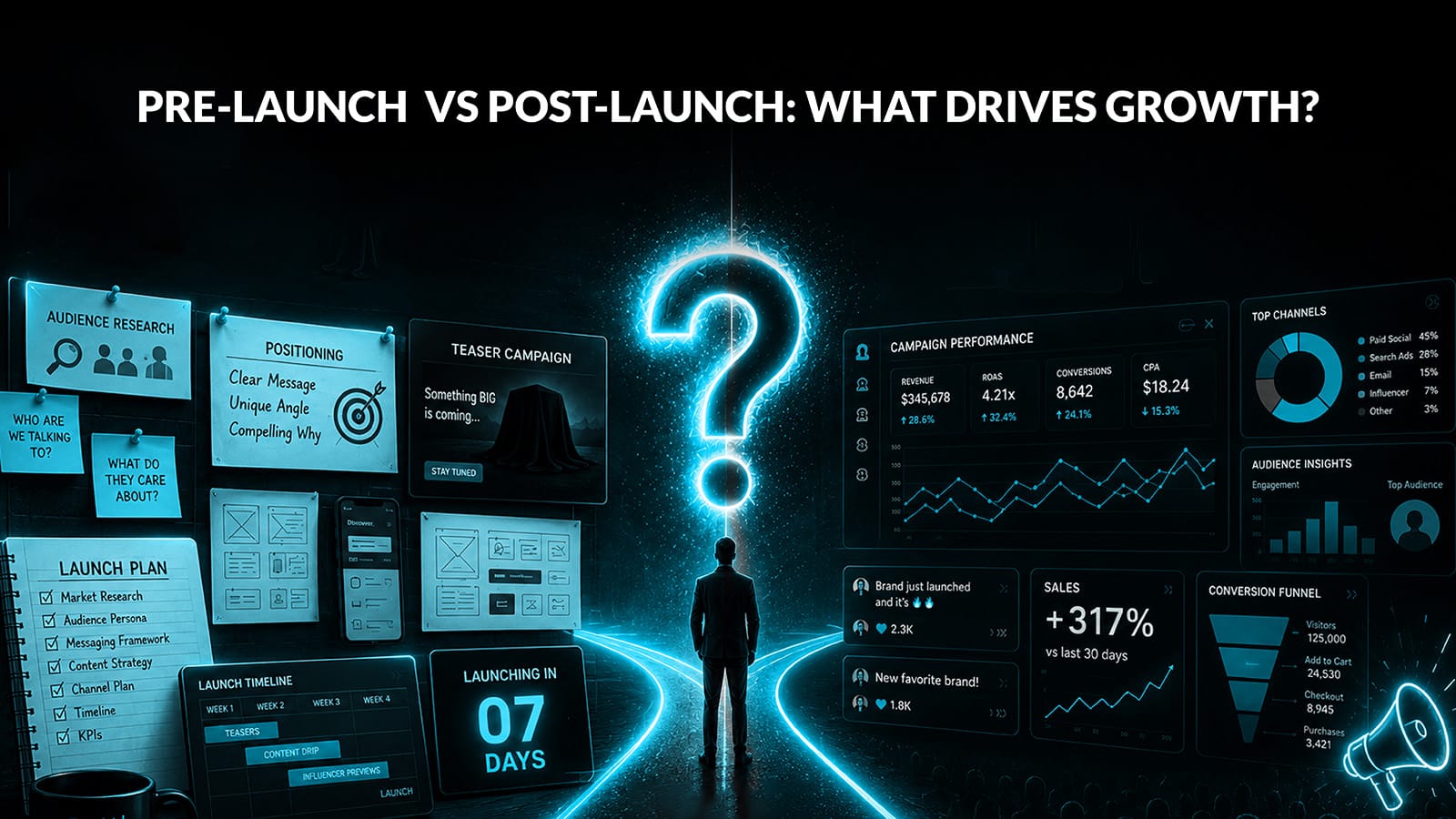
Pre-Launch vs Post-Launch Marketing: Why Most Brands Are Asking the Wrong Question
The brands that struggle after launch are rarely the ones with bad products or service. They’re usually the ones that misunderstood what launch was supposed to achieve.
Key Takeaways
- Most businesses treat launch as an event. Smart brands treat it as a transfer of momentum.
- A pre launch marketing strategy creates expectation. A post launch marketing strategy converts expectation into belief.
- The real purpose of pre-launch marketing is risk reduction.
- The real purpose of post-launch marketing is proof.
- Neither phase works in isolation. One creates demand. The other validates it.
- The brands that scale are the ones that connect both phases through a single launch marketing strategy.
The Debate That Exists Only Inside Boardrooms
Founders love launches. Marketing teams love launches. Investors love launches. Customers, interestingly, do not. Customers care about something much simpler: whether the thing they’re being promised is actually worth their attention. Yet every year, businesses spend enormous amounts of time debating where to focus their resources.
Should we invest more before launch? Or should we save our budget for after launch?
The question sounds sensible. It is also fundamentally flawed. Because customers don’t experience brands in phases. They experience them as a single story. The moment a prospect first hears about your brand and the moment they decide whether to trust it are part of the same journey. This is why the entire discussion around pre launch vs post launch marketing deserves a closer look.
What We Found After Watching Hundreds of Launches
Over the years, we’ve seen brands obsess over launch day. Countdowns. Teasers. Influencer collaborations. Media announcements. Launch events. And yet, some of the most anticipated launches disappear within months.
We’ve also seen the opposite. Brands that launch quietly, attract little fanfare, and go on to become category leaders.
The difference is rarely the campaign. The difference is what the launch was designed to do. Most businesses assume marketing begins when they start talking. In reality, marketing begins much earlier. It begins when the market starts forming expectations.
What Is Pre Launch Marketing Actually For?
Ask ten marketers what is pre launch marketing, and most will give you a variation of the same answer: Creating buzz before launch.
That’s partially true. But strategically, the role is much bigger. A strong pre launch marketing strategy exists to reduce uncertainty. Every customer asks three questions before considering a new product:
Who are you?
Why should I care?
Can I trust you?
The job of pre-launch marketing is to answer those questions before money enters the conversation. This is why effective pre launch marketing ideas begin with positioning.
The best pre-launch campaigns create confidence. By the time launch day arrives, customers should be waiting for the next chapter of your story.
The Problem With Launch-Day Success
Here’s where many brands get trapped: The launch works. Traffic spikes. Leads come in. Sales begin. Everyone celebrates. And then something unexpected happens.
The market starts paying attention.
For the first time, customers can evaluate reality against expectation. This is the moment where many launches begin to unravel. Because awareness is a promise. Experience is the proof. And proof is always harder.
The Real Job of Post-Launch Marketing
Most businesses think a post launch marketing strategy is simply about sustaining visibility, like running ads, publishing content, generating leads. But those are tactics.
The actual role of post-launch marketing is much more important. It exists to validate every claim made before launch. If pre-launch asks customers to believe, post-launch gives them reasons to continue believing.
Reviews become important. Customer experiences become important. Community building becomes important. Advocacy becomes important. Because at this stage, customers stop listening to the brand. They start listening to each other. The conversation has moved beyond marketing. It has entered reputation.
Why Some Launches Keep Growing While Others Fade
Think about the brands that dominate their categories. Most won because every post-launch interaction reinforced what people were promised before launch. This is where the strongest product launch marketing strategy differs from the average one.
The positioning developed before launch appears in the customer experience after launch. The promises made in campaigns appear in product delivery. The narrative remains consistent. Momentum never resets.
The Strategic Lens Most Brands Miss
The best launches are not divided into pre-launch and post-launch. They’re designed as a single system. Every activity before launch should make post-launch easier. Every activity after launch should strengthen the expectations created before launch. This is where a true launch marketing strategy differs from a collection of campaigns.
And it’s why successful brand launch services don’t stop at launch day. Because launch isn’t a milestone. It’s a transfer point. The moment responsibility moves from marketing to experience.
What This Means for Founders
Most founders think they need a better campaign. Often, they need better continuity. The market rewards the most believable story. Before launch, your job is to make people care. After launch, your job is to prove they were right to care. Everything else is execution. Which brings us back to the original question.
Pre-launch or post-launch? Both.
The brands that win understand that customers never see the line between the two. They only see whether the promise and the reality match. And when they do, growth becomes a natural outcome, not a marketing objective. A strong go to market strategy doesn’t end at launch. It simply changes hands.
Author Bio:
Karina Rupani
Five years into the creative hustle, Karina is a senior copywriter at Seagull who thinks in strategy and writes in human. With a reputation for finding the sharpest angle on even the most familiar brief, she has built brand narratives for startups finding their voice and legacy brands redefining theirs.
About Seagull Advertising
Seagull Advertising is a brand strategy agency and brand launch centre based in Pune, India. We work at the intersection of brand strategy, brand design, and go-to-market execution, helping organisations build brands that drive measurable business outcomes. Our proprietary frameworks, Wings for Profit, Wings for Design, and Wings for Reach, guide everything we do.