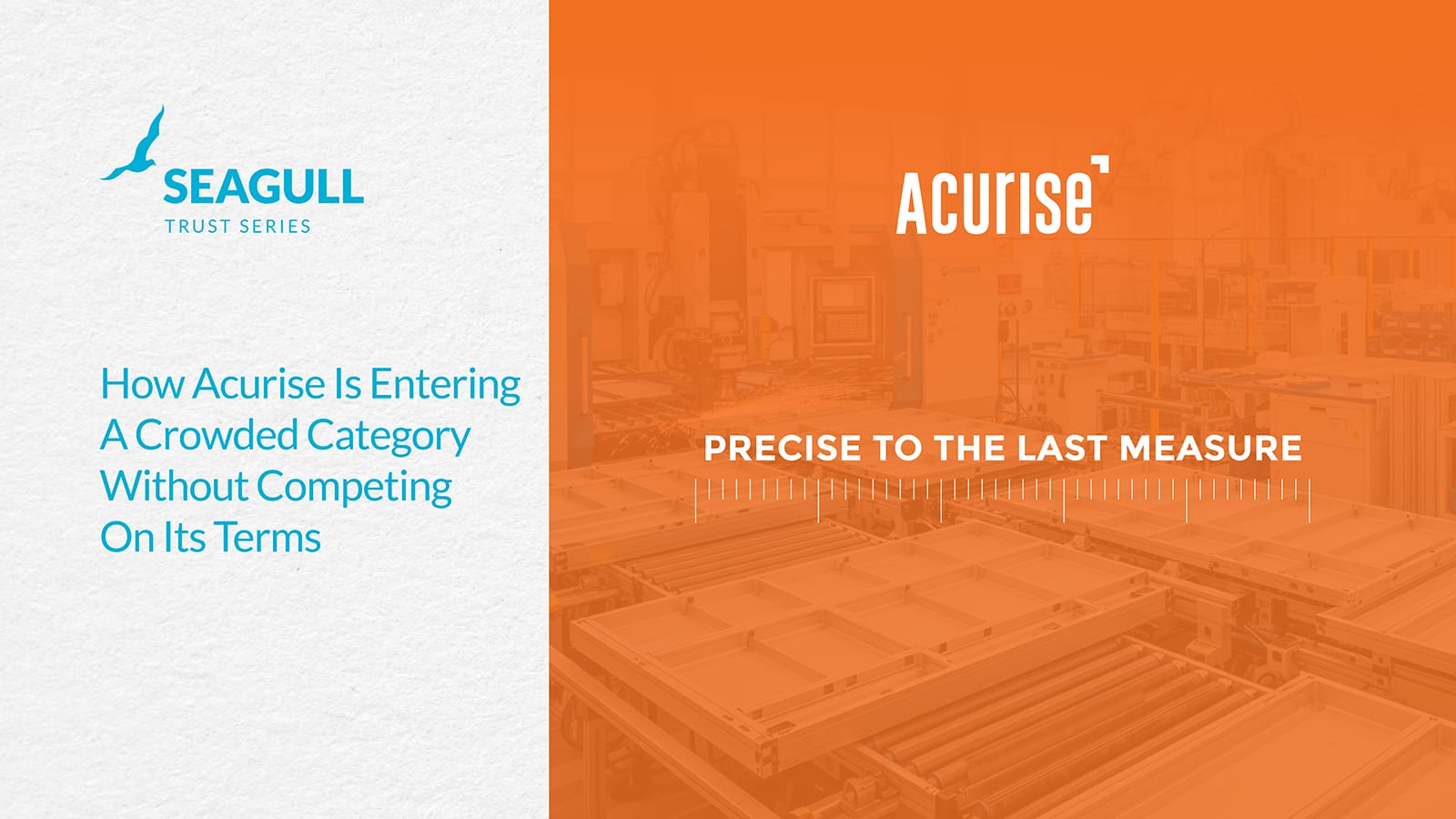
How Acurise Is Entering a Crowded Category Without Competing on Its Terms
Some brands enter a category by fighting for a slice of it. Acurise entered by refusing to be measured on the same scale as the category at all.
Key Takeaways
- Aluminium formwork is a mature, well-understood category. Every serious player already sells speed, cost and support.
- The B2B brand strategy was to sell the 50-year manufacturing legacy first, and the formwork second.
- Across 100 synthetic respondent profiles spanning developers, contractors, consultants, architects and project heads, one emotional truth scored highest by a wide margin: even a small error can become a big risk.
- Acurise didn’t build a formwork pitch around that truth. It built the entire brand around it.
- When a category sells features, the brand that sells discipline gets remembered first.
The Problem Everyone Was Ignoring
Aluminium formwork is not a new idea to the Indian construction market. Developers know what it does. Contractors have used it. Consultants have specified it. The category has been explained, demonstrated and sold for years.
Which is exactly the problem for anyone entering it now.
Walk through the pitch decks of the established names, and a pattern shows up quickly. Everyone is selling the same six things: speed of construction, cost competitiveness, inventory availability, engineering support, refurbishment capability, contractor relationships. Different brands, same vocabulary. The customer has heard all of it before, from someone else, usually at a lower price.
This is the quiet trap in every mature category. The more the players understand the customer, the more they start sounding like each other. Everyone converges on the same functional promises, because those promises are true, provable and easy to say. But provable and interchangeable are close cousins.
Acurise had to enter this exact market. And a straightforward pitch, built the way the category pitches itself, would have made Acurise the seventh voice saying the same six things.
What We Found When We Started Asking Questions
When Seagull, a branding agency in Pune known for its B2B branding services, began working on Acurise, the obvious brief would have been to write a strong formwork proposition. Better panels. Better tolerance. Better support. Faster cycles.
But the more we looked at where Acurise actually came from, the more that brief felt like it was underselling the company.
Acurise is founded by Rahul Shah, whose family has spent over 50 years running Associated Manufacturing LLP, a precision sheet metal and automotive component manufacturer working to tolerances measured in microns for Indian and global automotive giants. That is a manufacturing background, arriving to a construction category.
This changes the entire nature of the question. Most formwork companies are construction companies that got good at making formwork. Acurise is a precision manufacturing company that decided formwork was the next place to apply the same discipline.
The B2B brand strategy question we asked was direct: Should Acurise compete as a construction brand, or should it compete as a manufacturing brand that happens to operate in construction?
Those are not the same brand. One fights for share of a crowded, feature-driven category. The other imports credibility from a discipline the category has never had to answer to.
The Decision: Sell the Discipline, Not the Product
The answer was to build Acurise’s entire brand identity around the second option, and to make precision the organising idea for every single message, not a supporting feature buried in a specs sheet.
To find out if this instinct held up, Seagull, a B2B brand strategy agency, ran a structured internal exercise: 100 synthetic respondent profiles across developers, project heads, contractors, structural consultants, architects and procurement teams, each rated on ten Obvious Emotional Truths the Acurise brand could be built around. Truths like “the right formwork shapes confidence” and “flawless finish begins with flawless formwork” were tested against the field.
The exercise confirmed a principle central to effective B2B branding: the strongest brands are built on truths competitors cannot claim. One truth outscored everything else, and it wasn’t close: in high-rise construction, even a small error can become a big risk.
This single line does something no functional claim can. It speaks to a developer as a reputation risk, to a project head as an execution risk, to a contractor as a rework risk, to a consultant as a compliance risk, and to an architect as a finish risk. Six audiences, one fear, no translation required.
Acurise’s brand was built to answer that fear directly, using the one asset no formwork competitor in the category can claim: fifty years of proof that this level of precision is not new to the people making it. It was mastered in automotive manufacturing first, where the tolerance for error was already close to zero. And from this emerged: Precise To The Last Measure.
Why This Works When Feature-Selling Would Have Failed
A feature pitch tells a developer that Acurise’s panels are accurate. A legacy makes the developer ask why Acurise would settle for anything less.
There is a real difference between those two things. This is where effective B2B branding shifts the conversation from product comparison to strategic credibility.
Every competitor in this category can claim accuracy. Only Acurise can point to a facility that spent five decades supplying automotive giants who reject entire batches over deviations measured in microns, and say: this is the standard we are bringing here, not the standard we are aspiring to. This is the difference between a brand that asks to be trusted and a brand that arrives already trusted.
The Numbers Behind the Decision
The manufacturing facts are not a footnote here. They are the argument.
| Metric | Acurise |
| Manufacturing legacy | 50+ years, through Associated Manufacturing LLP |
| Origin industry | Automotive component manufacturing |
| Production capacity | ~7,000 sq. metres of formwork per month |
| Facility size | ~19,000 sq. ft. of production floor |
| Dimensional tolerance | ~±1.00 mm |
| Material standard | Aluminium Alloy 6061-T6, conforming to IS 733 and ASTM B221 |
| Top-scoring emotional truth (of 100 respondents, /1000) | “Even a small error can become a big risk” — 950 |
Every other brand in the category is describing what its formwork can do. Acurise is describing where its standards came from, and letting the customer draw the obvious conclusion about what that means on their site.
What This Means for Anyone Entering a Mature Category
Acurise’s aluminium formwork is genuinely well-engineered. That was never in question. What was in question is whether good engineering, described the way every competitor already describes theirs, would be enough to be remembered.
This is where most new entrants misjudge their situation. They assume that because their product is strong, the product will speak for itself. In a mature, well-understood category, it won’t. The market has already learned the category’s vocabulary, and it stops listening to more of the same words.
The same principle applies to any B2B go to market strategy: entering a mature category rarely requires louder messaging; it requires a stronger strategic truth. The real question worth asking, for any brand walking into a category that already has confident incumbents: are you selling what your product does, or where your standards actually came from? If every competitor can say the first sentence about themselves, the brand that wins is the one with a different second sentence.
Frequently Asked Questions
- What makes Acurise different from other aluminium formwork brands in India?
Acurise’s difference isn’t a formwork feature. It is the origin. The company is built on a 50-year precision manufacturing legacy through Associated Manufacturing LLP, which supplied automotive components to Indian and global manufacturers to tolerances far tighter than construction typically demands. - Why did Seagull choose “precision” as the central idea instead of speed or cost, which the category usually sells on?
Because speed and cost are already claimed by every established competitor, and testing across 100 synthetic respondent profiles showed that the fear of small errors compounding into large, visible, expensive problems scored highest across every audience segment, from developers to structural consultants. - What is an Obvious Emotional Truth (OET), and why was it used here?
An OET is the underlying fear or desire that sits beneath a category’s functional claims. For Acurise, ten possible OETs were tested against 100 synthetic respondents, and “even a small error can become a big risk” outscored the rest, becoming the foundation for the entire brand.
- How does this strategy help Acurise across different audiences like contractors, architects and procurement teams?
Because the same fear shows up differently for each. A developer hears reputation risk, a contractor hears rework risk, an architect hears finish risk, and a procurement head hears hidden cost. One brand idea, six relevant translations.
- How does brand strategy work alongside digital marketing?
A strong brand strategy makes every marketing effort more effective. As a B2B digital marketing agency, execution can drive visibility, but without a distinctive strategic position, marketing often amplifies the same messages as everyone else. Acurise demonstrates why strategy comes first.
- Does Seagull work with other manufacturing or construction-linked brands entering new categories?
Yes. Seagull works with manufacturing, real estate, education, consumer and enterprise brands, offering B2B branding services, brand strategy, design and B2B go to market strategy through its Wings for Profit, Wings for Design and Wings for Reach frameworks.
Author Bio:
Karina Rupani
Five years into the creative hustle, Karina is a senior copywriter at Seagull who thinks in strategy and writes in human. With a reputation for finding the sharpest angle on even the most familiar brief, she has built brand narratives for startups finding their voice and legacy brands redefining theirs.