Brand Strategy or Marketing Strategy? Why the Difference Decides How Fast You Grow
Key Takeaways
- Different questions, different jobs:
Brand strategy answers who a business is, marketing strategy answers how it gets discovered and sold. - In one line, what is brand strategy:
The emotional and behavioural foundation a business stands on, across every decision it makes. - In one line, what is marketing strategy:
The practical plan for reaching audiences, generating demand, and converting attention into sales. - The most expensive mix-up:
Treating brand building strategies as a marketing task, when direction is meant to come first. - The role of a specialist:
A capable brand strategy agency treats marketing as an output of strategy, rather than a replacement for it.
Ask ten founders to define brand strategy, and most describe a logo, a colour palette, or a tagline. Ask the same founders to define marketing strategy, and the answers blur further, ads, social posts, sometimes the entire marketing budget. The confusion is common, and expensive. Brand strategy and marketing strategy solve different problems, on different timelines, and mixing up the order is one of the fastest ways to spend a marketing budget while building very little brand recall.
The Compass, The Map, and Today’s Route
Brand strategy behaves like a compass. Fixed, directional, rarely redrawn. Marketing strategy behaves like a map. Flexible, full of routes and channels, redrawn as markets and platforms shift. Go-to-market strategy behaves like today’s route. A single, specific path, chosen for a specific launch, on a specific date.
Confusing these three costs businesses years of unclear direction, campaigns that look busy yet build little memory of what the brand actually stands for.
What Is Brand Strategy?
Brand strategy sits underneath everything a business does. It defines the emotional truth a business owns, the behaviour it commits to, and the reason a buyer chooses it over every alternative in the category.
At Seagull, this foundational work happens through Wings for Profit (W4P), where a business uncovers its Obvious Emotional Truth (OET), the belief a brand holds that a buyer feels, before a single ad gets written. Brand strategy rarely shifts year to year. It sets the rules that every campaign, every product decision, and every hire eventually follows.
What Is Marketing Strategy?
Marketing strategy sits on top of brand strategy. It translates the emotional truth into channels, campaigns, budgets, and timing.
Where brand strategy asks what a business stands for, marketing strategy asks how to reach the right person, at the right moment, with the right message. A strong marketing strategy shifts constantly, shaped by seasons, platforms, competitor moves, and audience behaviour, while the brand strategy underneath stays steady.
Different Types of Marketing Strategies, Explained Simply
Once brand strategy sets the direction, marketing strategy chooses the routes. A few common ones:
- Content marketing: builds authority through blogs, videos, and long-form storytelling.
- Performance marketing: drives measurable, fast action through paid digital channels.
- Retail and trade marketing: shapes visibility and conversion at the point of purchase.
- Influencer and social marketing: borrows trust from voices an audience already follows.
- PR and earned media: builds credibility through third-party validation.
The right mix depends on where an audience spends attention, and what the brand strategy underneath calls for.
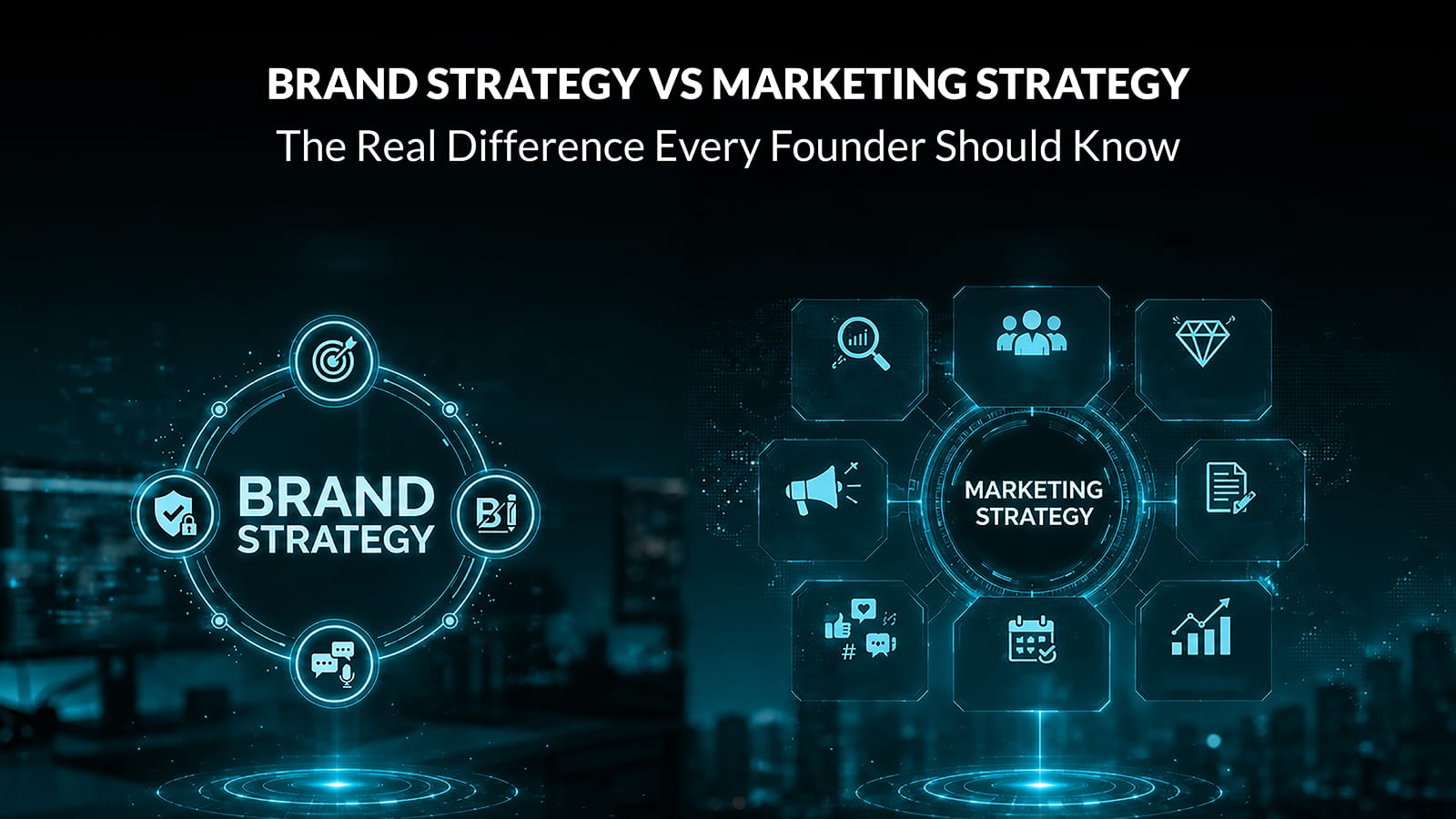
Brand Strategy vs Marketing Strategy:
The Practical Difference
| Brand Strategy | Marketing Strategy |
| Answers who a business is | Answers how a business gets seen |
| Stays steady across years | Shifts across quarters and campaigns |
| Defines the Obvious Emotional Truth | Defines channels, budgets, and creative execution |
| Guides every decision a business makes | Executes the decisions brand strategy sets |
Where Go-to-Market Strategy Fits In
A go-to-market strategy sits one level below marketing strategy, built for a single moment, a launch, a new city, a new product line. It answers what is go to market strategy in the most direct way: the specific plan for introducing an offering to a specific audience, through defined channels, within a set window. Once that window closes, the broader marketing strategy carries on. The GTM plan retires.
Why This Confusion Costs Businesses Growth
Founders often approach marketing first, plugging budgets into ads and content before the brand strategy underneath gets defined. Campaigns look busy, yet conversion stays inconsistent, because the message shifts every quarter along with the marketing calendar, while the emotional truth underneath stays undefined.
Strong brand building strategies start in reverse order: clarity first, channels second. A capable brand strategy agency treats every marketing decision as an expression of a brand’s OET, rather than a stand-alone creative exercise.
Building Both, In the Right Order
Businesses that grow with consistency put brand strategy in place first, marketing strategy second, and go-to-market plans last, built for specific moments. At Seagull Advertising, a branding company in Pune working across brand strategy and marketing execution, this sequence shows up in every engagement, direction ahead of distribution, position ahead of promotion. Skipping the order rarely saves time. It usually creates the confusion this article started with.
FAQs
- What is the main difference between brand strategy and marketing strategy?
Brand strategy defines the emotional truth and long-term direction a business holds. Marketing strategy defines the channels, campaigns, and tactics used to communicate that truth to an audience, season after season.
- What are the different types of marketing strategies a brand can use?
Common approaches include content marketing, performance marketing, retail and trade marketing, influencer marketing, and PR. The right mix depends on where an audience spends attention and what the brand strategy underneath calls for. - How does a go-to-market plan differ from a marketing strategy?
A marketing strategy runs continuously across quarters and campaigns. A go-to-market plan runs once, built for a single launch, a new city, or a new product line, with a defined start and a defined close. - Does a business need brand strategy before marketing strategy?
Direction usually comes before distribution. A business that defines its emotional truth first tends to spend marketing budgets with more consistency, since every campaign pulls toward the same core idea instead of reinventing the message each quarter. - How long does brand strategy take to show results, compared to marketing strategy?
Brand strategy work shapes decisions for years, and its impact builds gradually across every touchpoint. Marketing strategy tends to show results faster, often within weeks or months, since campaigns and channels get evaluated in real time.