Why Ecommerce Brands Need Strong Branding First
KEY TAKEAWAYS
- Performance Marketing ≠ Brand Building: Conversions without brand recall lead to short-term spikes, not sustainable growth.
- Rising CAC Is a Symptom: Over-reliance on performance marketing inflates costs and reduces profitability over time.
- Branding Builds Memory Structures: Strong brands reduce dependency on paid media by creating recall and preference.
- Trust Drives Transactions: In e-commerce, branding replaces the physical experience thereby making trust non-negotiable.
- Integration Is the Answer: The most successful brands align performance marketing with a strong branding foundation.
Introduction: The Performance Marketing Trap
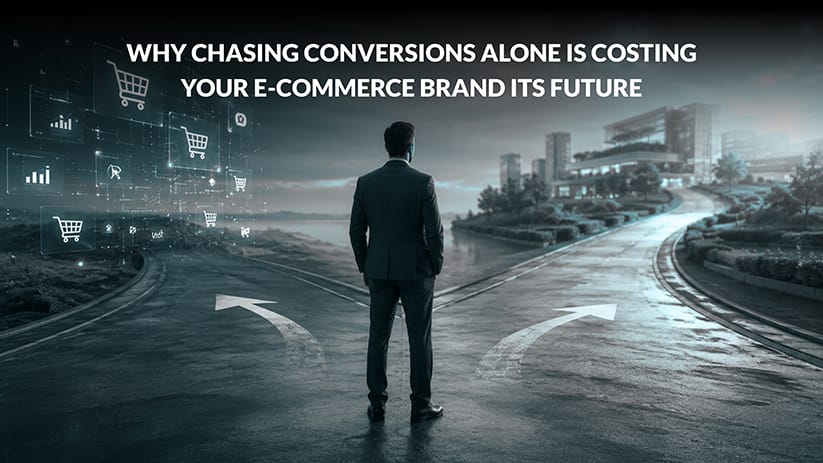
E-commerce has made growth look deceptively simple. Run ads. Optimise funnels. Scale budgets. Repeat. And for a while, it works. But then something changes. Costs rise. Conversions drop. Growth hits stagnancy. This is the point where most e-commerce brands realise a hard truth: performance marketing can drive transactions, but it cannot build a brand. This is where branding for e-commerce begins to move from being optional to essential.
Most e-commerce brands are built on performance marketing from day one. Every sale is attributed to an ad. Every growth spike is linked to spending. And the result? A dangerous dependency. The moment you reduce ad spend, sales drop. Visibility disappears. Momentum collapses. If your brand stops selling the moment ads stop running, you don’t have a brand, you have a system on rent. But here’s the real shift: strong branding reduces this dependency. It creates memory, familiarity, and preference, so customers return without being chased. This is the foundation of e-commerce brand management, where growth is sustained beyond paid visibility.
In a highly competitive digital marketplace, products are increasingly becoming indistinguishable. If you scroll through any e-commerce platform, you’ll notice a pattern: similar products, similar pricing, similar promises. Without branding, your product becomes interchangeable. And when that happens, the only way to compete is through lower prices, higher discounts, and more aggressive ads. However, this results in shrinking margins, declining perceived value, and disappearing loyalty. The real solution lies in understanding your e-commerce brand meaning i.e. what your brand stands for beyond the product. For businesses wondering how to build an e-commerce brand, the answer lies in creating differentiation that customers can emotionally connect with and remember. Branding gives your product meaning beyond functionality, and transforms it from a choice into a preference. At Seagull, a leading e-commerce branding agency in Pune, this begins with identifying your Obvious Emotional Truth (OET), the intersection of what your business sells and what your audience truly feels.
Equally important is the role branding plays in building trust. In physical retail, customers can see, touch, and experience a product. In e-commerce, they cannot. Which means one thing: your brand becomes your storefront. Every visual, every message, and every interaction contributes to a perception of credibility. Consistency in communication, clarity in positioning, and cohesion in design are not just creative choices. They are signals of reliability. These are some of the most critical advantages of branding in e-commerce, especially in a trust-deficit environment.
While branding is crucial, it is equally important to acknowledge the rising cost of acquisition. Customer Acquisition Cost (CAC) is increasing across platforms. Algorithms are getting smarter, and competition is getting fiercer. Performance marketing alone cannot solve this, because it optimises for the present. Branding, on the other hand, invests in the future. A strong brand improves click-through rates, increases conversion efficiency, and drives organic and repeat sales. In simple terms, branding makes your performance marketing work harder. This is why businesses actively exploring how to build an e-commerce brand are increasingly shifting focus from short-term gains to long-term equity.
At Seagull Advertising, we view brand growth as a three-dimensional system. As a brand strategy consulting agency and a leading branding company in Pune, we believe growth is not the result of isolated efforts but of structured alignment:
Wings for Profit (W4P)
Defines your Obvious Emotional Truth and strategic foundation.
Wings for Design (W4D)
Transforms strategy into a distinctive and consistent brand identity.
Wings for Reach (W4R)
Ensures your brand reaches the right audience with precision and scale.
Performance marketing is a part of reach. But without profit and design, it cannot sustain growth. This is where the role of an experienced e-commerce branding agency becomes critical in aligning all three dimensions.
The most successful e-commerce brands do not choose between branding and performance. They integrate both. Because branding builds demand, and performance captures it. One creates desire; the other converts it. Without branding, performance becomes expensive. Without performance, branding becomes invisible. This balance is at the core of how to build a successful e-commerce brand in today’s competitive landscape. An insightful e-commerce branding agency helps ensure this balance is strategically maintained across every customer touchpoint.
Final Thoughts
E-commerce is no longer just a game of clicks and conversions. It is a game of memory, trust, and long-term preference. If your growth depends entirely on performance marketing, you are building on borrowed momentum.
To scale sustainably, you need more than campaigns. You need a brand built with clarity, consistency, and emotional relevance. Partnering with the right e-commerce branding agency can help businesses move beyond short-term conversions and build long-term brand preference. Because in the long run, brands that win are not the ones that shout the loudest, but the ones people remember.
Author Bio:
Shubhankar Khasgiwale
An advertising enthusiast with 8+ years of experience, Shubhankar is a copywriter who thinks in stories and writes in rhythm. Inspired by poetry and music, he brings emotion and depth into every brand narrative he creates.
FAQs
- What is the difference between branding and performance marketing?
Branding builds long-term recall, trust, and emotional connection, while performance marketing focuses on immediate conversions and measurable ROI. - Can e-commerce brands grow with performance marketing alone?
They can grow initially, but without branding, growth becomes expensive and unsustainable over time. - How does branding reduce CAC?
Strong branding improves recognition and trust, leading to higher conversion rates and repeat purchases, reducing dependency on paid acquisition. - When should an e-commerce brand invest in branding?
Ideally, from the beginning. But even established brands should strengthen branding to break performance dependency. - How can Seagull help e-commerce brands?
Through its Three-Wings Framework, aligning strategy, design, and reach to build scalable, sustainable growth.